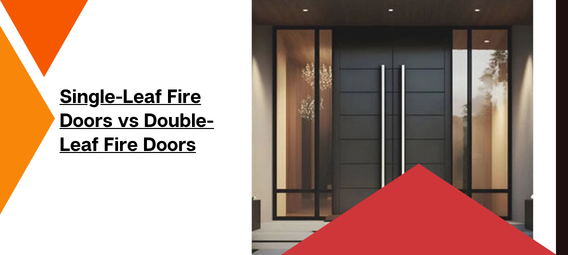
A doorway that measures 900 mm cannot pass through the same fire door as a loading bay built for pallet trolleys. Leaf configuration affects how a fire door performs day to day and during an evacuation. Single-leaf and double-leaf fire doors are the two configurations used across most buildings. Available wall and doorway space, along with expected traffic, settles which one fits a given opening.
What Is a Single-Leaf Fire Door?
A single-leaf fire door carries one door panel set into one frame. It operates independently, hung on hinges fixed to a single side, closing via a single self-closing device with no second leaf to align against. The hardware stays minimal: one set of hinges, one door closer and one latch or lock set.
Most single-leaf fire door installations suit openings up to around 1000 to 1200 mm wide. That covers offices, corridors, utility rooms, stairwell entries, and smaller storage rooms, in which one person or a narrow trolley passes through at a time.
What Are Double-Leaf Fire Doors?
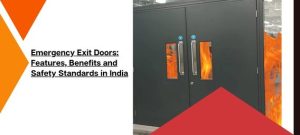
A double-leaf fire door system fits two leaves into one frame, usually cut to unequal widths. The wider leaf, the active leaf, handles daily traffic and carries the main lock. The narrower leaf, the inactive leaf, stays closed when not in use, secured by flush bolts top and bottom, and opens only when the full width is needed.
Two independently moving leaves need coordinating hardware. A door coordinator makes sure the inactive leaf closes and locks first, so the active leaf shuts against it without gapping the frame. This configuration suits loading entrances, hospital corridors, plant rooms, and any opening built to pass beds, trolleys, or wide equipment.
Single-Leaf vs Double-Leaf Fire Doors: Key Differences
Available Opening Width
A single leaf covers standard door widths without difficulty. Past roughly 1200 mm, one leaf becomes heavy to operate and harder to source in a fire-rated frame. Splitting the same opening into two leaves keeps each panel a manageable size while still filling the wider gap.
Space and Door Swing
Single-leaf doors need less floor clearance to swing open. Double-leaf doors, especially when both leaves open together, need a wider clear zone on the approach side. Corridors with fixed furniture or tight turns often decide which configuration leaves more usable floor space.
Installation and Hardware
A single-leaf door installs with one set of hinges, one closer, and one lock. Double-leaf doors add a second closer, flush bolts on the inactive leaf, and a coordinator to sequence the closing order. More hardware means more points to check during annual fire door inspections.
Everyday Traffic and Accessibility
Corridors with steady foot traffic, wheelchairs, or trolleys move faster through a wide single leaf or a double-leaf opening than through a narrow door. Storage rooms and offices with light, occasional use rarely need the extra width a double-leaf door provides.
Fire Performance
Both configurations hold their fire rating when built, tested, and installed as a complete door assembly. The frame, intumescent seals, hardware, and glazing, where fitted, all contribute to that rating alongside the leaf itself. Leaf count alone does not raise or lower fire resistance. Installation quality does.
Difference Between Single Leaf And Double Leaf Door
| Factor | Single-Leaf Door | Double-Leaf Door |
| Typical opening width | Up to 1200 mm | 1200 mm to 2400 mm and above |
| Number of leaves | One | Two, active and inactive |
| Core hardware | Hinges, one closer, one lock | Hinges, two closers, coordinator, flush bolts |
| Swing clearance required | Lower | Higher |
| Common settings | Offices, corridors, stairwells | Loading bays, hospital corridors, plant rooms |
When Should You Choose a Single-Leaf Fire Door?
A single-leaf door suits standard-sized openings where traffic stays moderate and space is limited. Operation stays simple: one leaf, one closer, one lock to service. Fewer moving parts also mean a shorter maintenance checklist during routine inspections.
When Is a Double-Leaf Fire Door a Better Choice?
A double-leaf door is preferred if the opening has to pass more than one person at a time, such as loading areas, hospital wards, or plant rooms handling bulky equipment. Splitting the width across two leaves keeps each panel a suitable size while the full opening still meets the required fire rating.
Conclusion
Available space, opening width, traffic, and fire-safety requirements together decide whether a single-leaf or double-leaf configuration is suitable for a particular doorway. Neither option outperforms the other on fire resistance. The choice depends on how the opening is used on a daily basis. MP Swastik Doors manufactures both single-leaf and double-leaf fire doors built to fit these requirements. Contact us to discuss the right configuration for your opening.