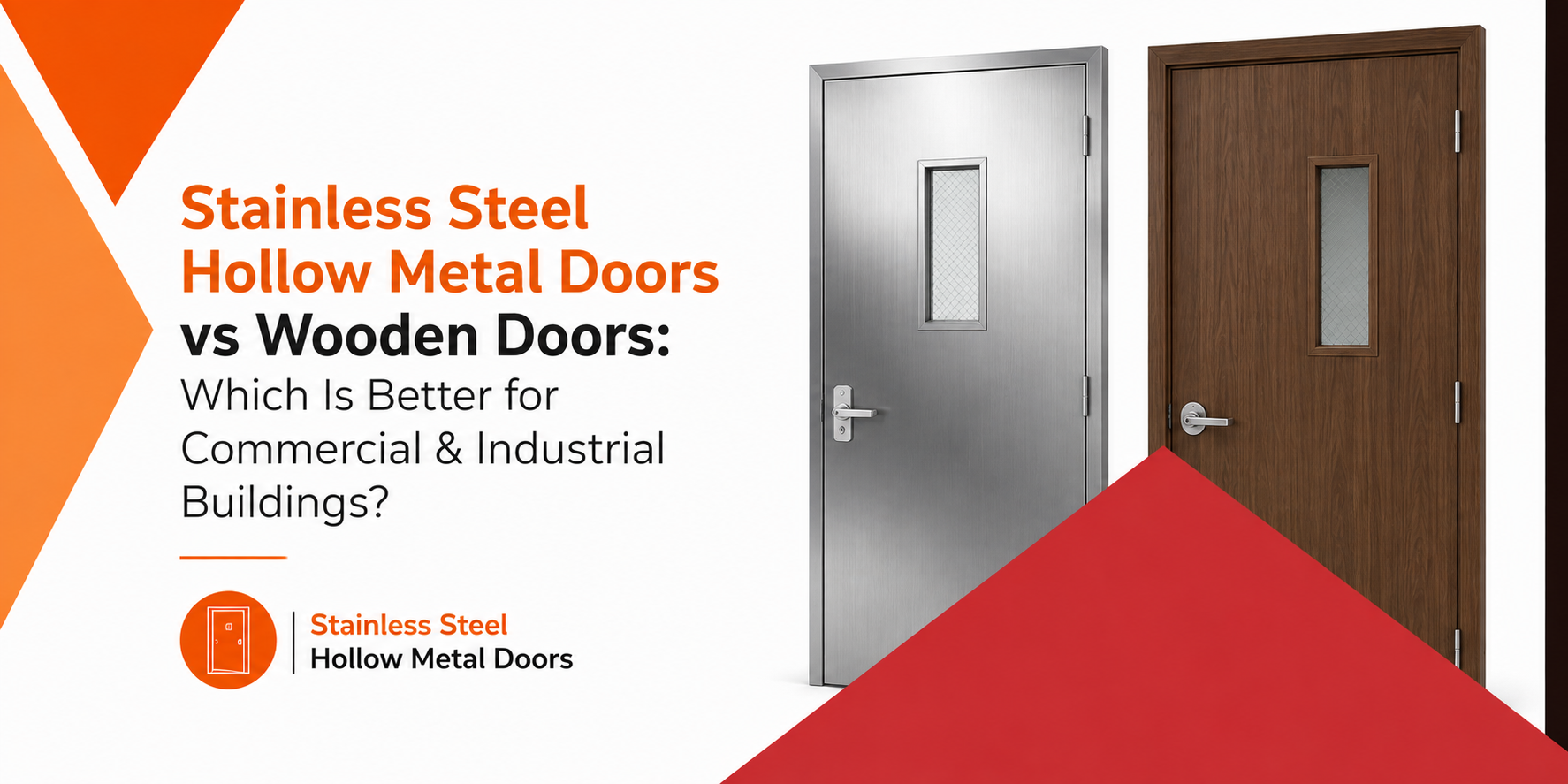
Commercial and industrial buildings need doors that survive heavy use, fire risk, and years of daily traffic. Stainless steel hollow metal doors and wooden doors both serve as entry barriers, but they perform very differently under real conditions. This blog compares both on durability, fire resistance, and maintenance to help architects, contractors, and facility managers decide.
What Are Stainless Steel Hollow Metal Doors?
The stainless steel hollow metal door features a reinforced core set within a rigid steel frame, built to resist impact without bending or cracking. The skin is made from sheets of stainless steel, and the inside is reinforced with honeycomb, polyurethane or mineral wool. Resistant to corrosion, able to withstand heavy daily use, and fire rated to standards that timber rarely reaches. Main entrances, fire exits and service rooms are common uses.
What Are Wooden Doors?
A wooden door is built from solid timber, engineered wood, or a flush-core panel with veneer facing. Solid wood offers a natural finish; engineered wood resists warping better; flush doors keep costs low. But wood absorbs moisture, swells in humid conditions, and needs a fire-rated core to meet basic commercial codes. Most wooden doors serve homes and light-duty interiors.
Stainless Steel Hollow Metal Doors vs Wooden Doors
This table compares both door types on the factors buyers care about most.
| Feature | Stainless Steel Hollow Metal Doors | Wooden Doors |
| Strength | Excellent | Moderate |
| Durability | Very High | Moderate |
| Fire Resistance | Excellent | Limited (unless fire-rated) |
| Corrosion & Moisture Resistance | Excellent | Susceptible to moisture |
| Maintenance | Low | Moderate to High |
| Lifespan | Long | Moderate |
| Security | High | Moderate |
| Best Applications | Commercial & Industrial Buildings | Homes & Interior Spaces |
Durability and Structural Strength Comparison
Continued contact will frequently cause the hinges and edges to crack or warp, sometimes in months. Stainless steel hollow metal doors will hold their shape for thousands of cycles, keeping the frame aligned and the locks operating. This means less maintenance and a longer service life.
Fire Safety and Security: Which Door Performs Better?
Fire-rated steel doors keep the fire and smoke out for 60 to 120 minutes, allowing occupants to escape. Wood only gets close with a special fire resistant core, and still falls behind on smoke containment. Steel also resists forced entry much better than timber, which can be kicked through or prised open. There is a high demand for certified metal doors in hospitals and public buildings due to safety regulations.
Maintenance and Long-Term Cost Comparison
Steel doors don’t rust, are resistant to termites or moisture, and require little cleaning, keeping lifetime costs well below the regular maintenance costs of wood.
| Factor | Stainless Steel Hollow Metal Doors | Wooden Doors |
| Cleaning | Easy | Regular polishing/maintenance |
| Moisture Resistance | Excellent | Low |
| Termite Resistance | Complete | Vulnerable |
| Maintenance Cost | Low | Higher |
| Service Life | Longer | Shorter |
Where Are Stainless Steel Hollow Metal Doors Commonly Used?
Office Buildings
Main entrances see the most traffic in a day, and steel doors hold up without warping at service rooms and access points.
Industrial Plants & Manufacturing Plants
Machinery areas and production floors need heavy duty doors that can withstand vibration and constant movement.
Hospitals and Healthcare Facilities
Patients are protected by fire-rated applications, but hygienic environments require easy-to-clean, bacteria-resistant surfaces.
Educational Institutions
Steel doors, in continuous use in classrooms, laboratories and administrative buildings, will outlast timber doors by a large margin.
Warehouses & Logistics Centers
High security entry points with doors able to withstand forklift impact and equipment movement are present in inventory and storage and loading areas.
How to Choose the Right Door for Your Building
Start with the type of building and the use of space. Then there are security requirements, for a high-value inventory that calls for doors that resist forced entry. Compliance to fire safety is important and humid regions accelerate wood decay not much for steel. Check maintenance expectations, lifecycle budget and custom or fire rated requirements.
| Building Type | Recommended Door |
| Commercial Offices | Stainless Steel Hollow Metal Doors |
| Industrial Plants | Stainless Steel Hollow Metal Doors |
| Warehouses | Stainless Steel Hollow Metal Doors |
| Hospitals | Stainless Steel Hollow Metal Doors |
| Educational Institutions | Stainless Steel Hollow Metal Doors |
| Residential Interiors | Wooden Doors |
Why Choose MP Swastik Doors for Stainless Steel Hollow Metal Doors?
MP Swastik Doors manufactures stainless steel hollow metal doors built for commercial, institutional, and industrial projects where door failure is not an option. The range includes fire-rated and heavy-duty configurations with custom sizing. Production runs through a 100,000 sq. ft. facility in Wada, Palghar, with separate units for design, manufacturing, quality testing, and warehousing, ensuring consistent output on large orders.
Conclusion
Wooden doors suit homes and light interior spaces, but fall short once a building needs fire resistance, high security, or constant daily use. Stainless steel hollow metal doors outperform wood on strength, fire safety, corrosion resistance, and maintenance cost, making them the stronger choice for commercial and industrial buildings.
Learn more about stainless steel hollow metal doors, including their features, applications, and performance benefits, by visiting the complete guide from MP Swastik Doors.