Commercial and industrial properties rely on rolling shutters for one core reason: protection that stands up after hours. Perforated rolling shutters and solid rolling shutters both deliver that protection, but they solve different problems. One lets light and air through a perforated slat pattern. The other seals the opening completely. Visibility, airflow, and application all shift depending on which type sits on your storefront or warehouse door. The right pick depends on your security needs, business type and how the space gets used day to day. This comparison breaks down both options so you can match the shutter to the property.
Understanding Perforated Rolling Shutters and Solid Rolling Shutters
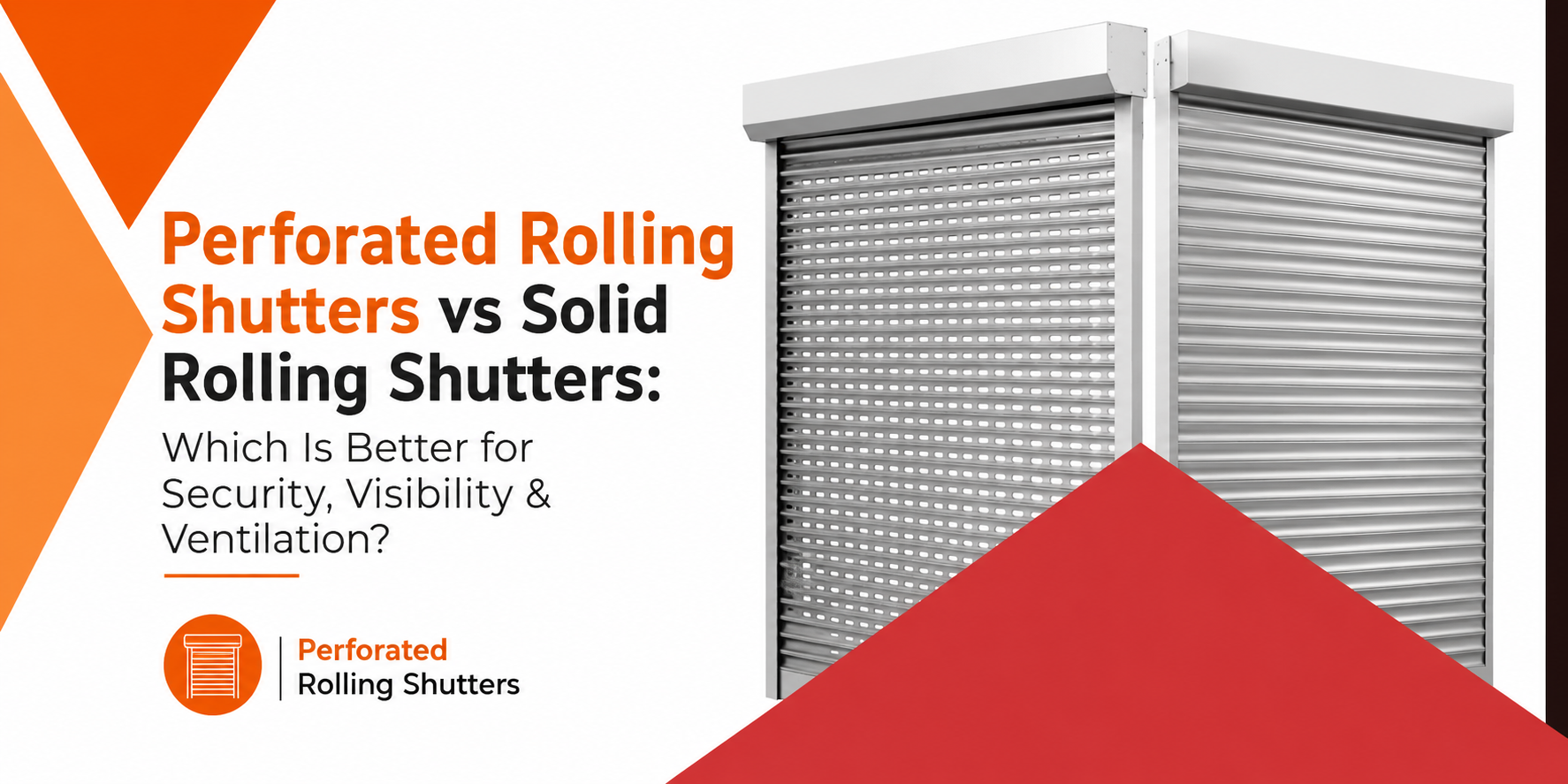
Perforated rolling shutters use slats punched with small, evenly spaced holes. This design permits airflow through the space, while passersby can see partial outlines of a storefront. Galvanized steel and aluminum are the two most common materials used for corrosion resistance and long-term wear. Retailers, mall units, and showrooms favor this style because it protects merchandise overnight without hiding the storefront completely. The perforation pattern also cuts down on heat buildup behind the shutter during closed hours.
Solid rolling shutters run on a different principle: full-panel slats with no gaps. Nothing passes through, not light, not air, not a passing glance from the street. That closed construction gives warehouses, factories, storage units, and high-security facilities a barrier that blocks visual access entirely. Where perforated units aim for balance, solid shutters aim for total enclosure.
Perforated Rolling Shutters vs Solid Rolling Shutters
Eight factors separate these two shutter types, from security level to appearance. The table below lines them up side by side.
| Feature | Perforated Rolling Shutters | Solid Rolling Shutters |
| Security | High | Maximum |
| Visibility | Partial | None |
| Ventilation | Excellent | Minimal |
| Natural Light | Allows Partial Light | Blocks Light |
| Privacy | Moderate | Complete |
| Appearance | Modern & Attractive | Functional & Industrial |
| Best Applications | Shops, Malls, Showrooms | Warehouses, Factories, Storage Units |
Which Shutter Offers Better Security?
Solid shutters seal a property behind a continuous metal surface, leaving no gap for a passerby to see through or reach into. Perforated rolling shutters hold their own too. The perforation is engineered into the slat, not cut as a weak point, so the shutter resists forced entry while keeping the storefront visible. Slat thickness, the locking mechanism, and installation quality decide the real-world security level more than the perforation itself. A professionally installed perforated shutter with a solid locking system matches the protection most businesses need.
Applications of Perforated and Solid Rolling Shutters
Different property types demand different shutter behavior, and each shutter style fits a distinct set of use cases across commercial and industrial settings.
Retail Stores & Shopping Malls
Perforated shutters allow partial visibility of the product displays even when the store is closed. Storefronts gain a cleaner, updated look. Security is maintained without hiding the entire shop.
Showrooms & Commercial Spaces
Showrooms use perforated shutters to display products even after business hours end. The design also adds a modern, architectural finish to the frontage.
Warehouses & Storage Facilities
Warehouses benefit from solid shutters for ultimate security and total privacy. This keeps valuable inventory out of sight and safe from opportunistic access.
Industrial Units & Manufacturing Plants
Manufacturing floors need heavy-duty security for machinery and equipment. Solid shutters provide that reliable, continuous barrier across long operating hours.
Parking Areas & Commercial Buildings
Parking garages are ventilated using perforated designs. It allows secure access management while providing limited visibility.
How to Choose the Right Rolling Shutter for Your Business
Match the shutter to your operational priorities using these points as a starting checklist.
- Assess your security requirements based on the value and type of assets stored on site.
- Consider whether your business needs visibility for product display or complete privacy instead.
- Take into account ventilation needs, particularly in parking spaces or semi-enclosed areas.
- Match the type of shutter to your business type (retail, industrial or storage).
- Choose between galvanized steel and aluminum based on load and corrosion exposure.
- Use manual or motor operation based on usage.
- Weigh your budget against long-term maintenance costs before finalizing a shutter type.
Conclusion
Perforated and solid rolling shutters both protect a property, but they answer different questions. Perforated rolling shutters suit businesses needing security alongside visibility and airflow, particularly retail and showroom spaces. Solid shutters suit operations where privacy and maximum security outrank visibility. The right choice depends on property type, operational needs, and where security ranks against display and ventilation. MP Swastik Doors manufactures both shutter types with the material grades and fittings these applications call for.